GravityFinder: see what you would weigh on 6,000+ exoplanets, free and without an account
- Web Apps
What would you weigh on Mars? On a gas giant 245 light-years away? GravityFinder answers that for thousands of worlds. It is a free website built on NASA's exoplanet data, and it takes the weight question as a way into the catalog. It was shown on Hacker News this week, and I spent a few minutes with it.
The weight tool
The home page at gravityfinder.com opens with a box labelled "Your Earth weight", with a pound and kilogram switch. It started at 150 and said that on Mars it would be 56.7 lb, with a note that Mars has 0.38 times Earth's gravity. I typed 70 and the Mars figure became 26.5 lb, which matches the same 38 percent. Buttons below compare Earth, Moon, Mars, Venus, Jupiter and Saturn, and the site lists their gravity (for example 2.53 g for Jupiter).
The box starts in pounds, so check the unit before you read the result: my 70 meant 70 lb. I did not test the kilogram option.
A planet page
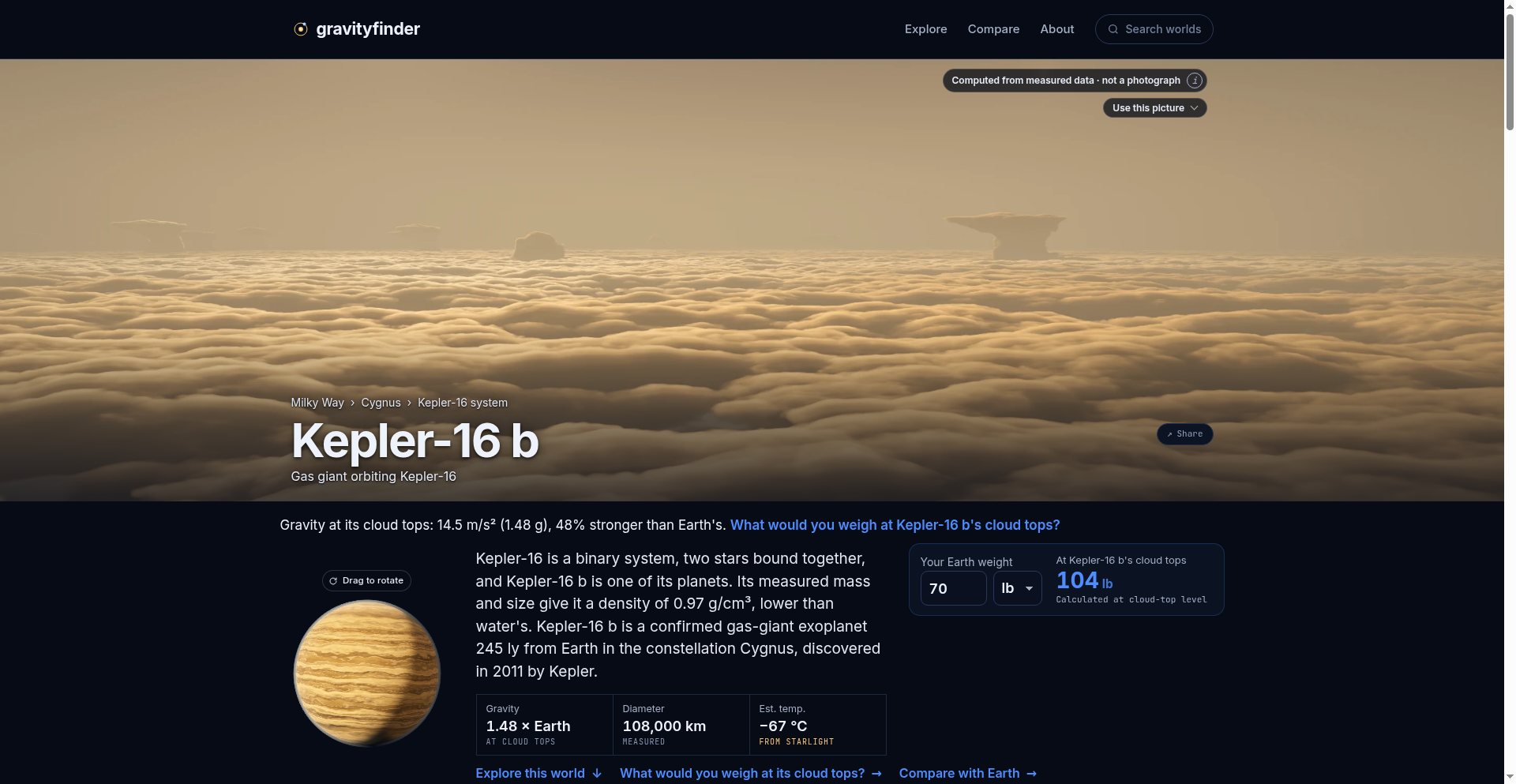
I opened Kepler-16 b, a gas giant that orbits two stars. The page showed gravity at its cloud tops as 1.48 times Earth's, a diameter of 108,000 km, an estimated temperature of minus 67 degrees Celsius, a distance of 245 light-years and a discovery year of 2011. With my 70 lb weight entered, it showed 104 lb at the cloud tops, which matches 1.48 times 70. The page marks values as "measured", "from starlight" or calculated, and says "Gas giant, no surface", so the weight is explained as a cloud-top figure and not a place you could stand.
The big picture on the page is labelled "Computed from measured data, not a photograph". The About page says the pictures not taken by a telescope are drawn by the site's own program from each world's data, not by an AI image generator, and that they may be reused with a credit link. The Mars and Earth pictures come from NASA maps, with credits shown on the page.
Rankings and comparing
The "most Earth-like" list says it ranks 5,892 worlds by an Earth Similarity Index, starting with Wolf 1069 b (index 0.97, 31.3 light-years away, about 75.6 lb for my 70 lb weight), then TRAPPIST-1 e and Teegarden's Star b. The Compare page puts two worlds side by side at the same scale, starting with Mars and Earth, and lets you add a third.
What the site says about its data
These are the site's statements, which I did not check. It says worlds, stars and systems come from the NASA Exoplanet Archive (6,473 confirmed planets), galaxies from OpenNGC, and merging black holes from the LIGO, Virgo and KAGRA open data. It says each value is either a published measurement or computed from a public formula, and that gaps are left blank. The publisher is listed as 137 Finder LLC. I saw no sign-up or price on the pages I opened.
What I did not test
I did not compare the numbers with the NASA archive, try the galaxy, black hole or notable star pages, use the search box, or check the site on a phone. The About page says the "Observe" part, which links objects to the night sky, is still being built.
Who it is for
This is our view: it is a good fit for curious people, students and teachers who want a friendly way into exoplanet data. If you need full parameter tables for research, go to the NASA Exoplanet Archive, which the site names as its source.
Link: gravityfinder.com. What is described here is what the site showed on November 28, 2026. Source for the launch: the HN Showcase listing.
Cover: our own capture of the Kepler-16 b page on gravityfinder.com, November 28, 2026. The landscape is a computed image by gravityfinder.com, not a photograph.