Malware loader slipped into open-source pull requests, CircuitVerse deletes 40 installers
- Security
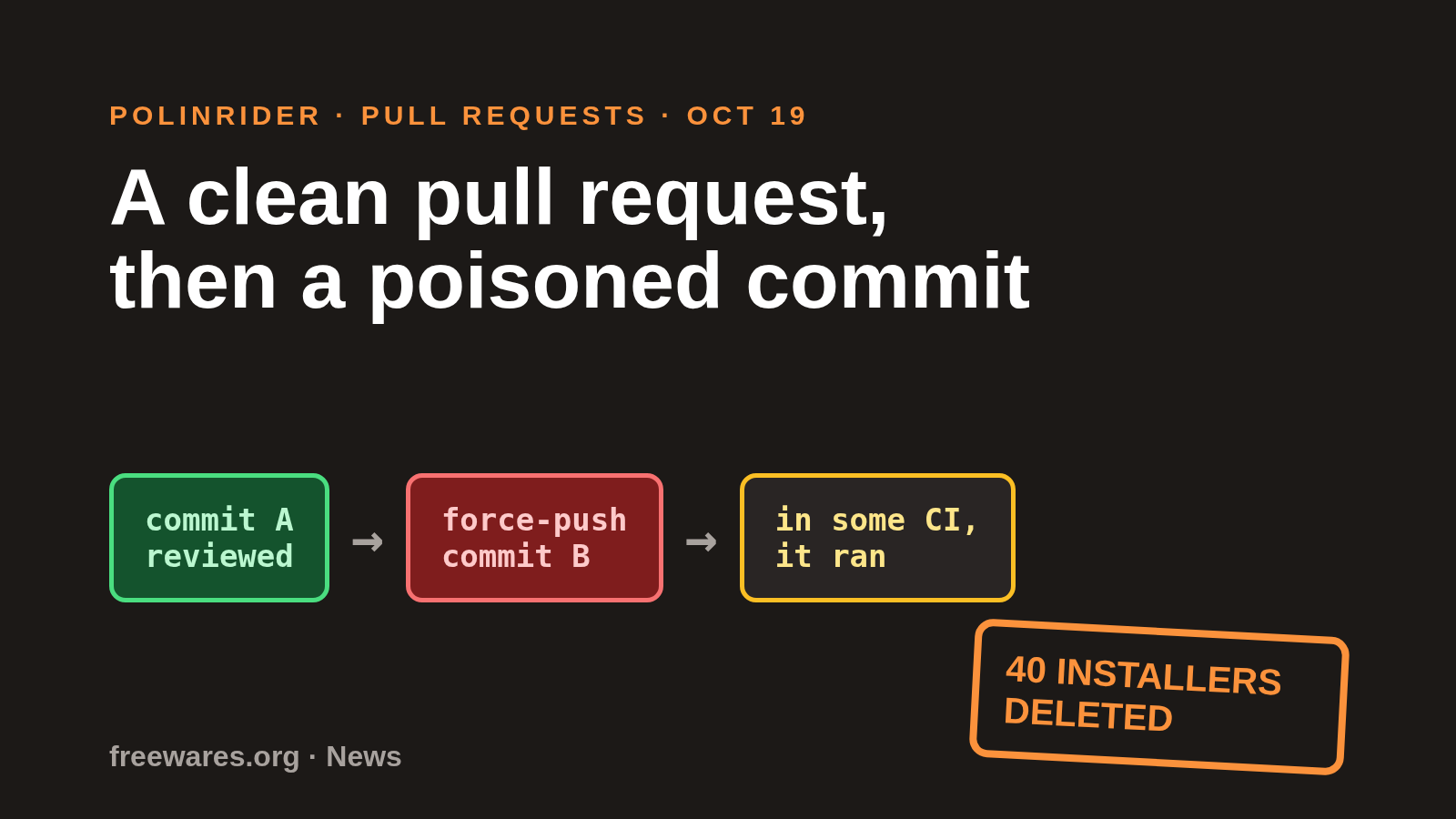
A malware loader was hidden in open-source pull requests, and in one project it ran in the build that makes the desktop installers. According to the security firm StepSecurity, the maintainers of CircuitVerse confirmed the loader ran in their release workflow and deleted the 40 installers it published.
What StepSecurity says happened
In a report dated November 26 and updated November 27, StepSecurity says that on October 19, rewritten commits carrying a hidden loader were force-pushed into open pull requests at AsyncAPI Generator, CircuitVerse, Open Food Facts and Jaeger. The commits came from a GitHub account that GitHub suspended on November 25. A force-push replaces a commit on a branch, and StepSecurity says that at AsyncAPI each bad commit stayed 30 to 40 minutes before a second push left a clean final diff.
StepSecurity says the loader belongs to PolinRider, a malware family it describes as hiding JavaScript in build configuration files and fake font files, and stealing credentials from developer machines. The firm says none of the account's 145 merged pull requests contains the loader, as checked by maintainers at several projects.
What ran
StepSecurity says CircuitVerse's pull request workflows ran the loader without approval, including the release workflow that builds its desktop app for Windows, Linux and macOS. CircuitVerse's maintainers confirmed it and deleted the 40 installers that workflow published. The firm says Open Food Facts' CI also ran it, and that the project rotated a secret. At AsyncAPI, StepSecurity says CI did not run it because fork pull requests need a maintainer's approval, and Jaeger's maintainers confirmed theirs did not either.
Wider campaign
The Hacker News, citing researchers at Apiiro and SafeDep, reports that PolinRider has compromised more than 7,600 GitHub repositories and is linked to North Korean actors. It says a Python loader was found in 375 public repositories and that there is no evidence it spread through PyPI or npm. Part of the campaign uses fake recruiters who ask candidates to run a project as a take-home test. These figures come from the researchers, not from us, and we have not checked them.
What to do
Our advice: if you installed the CircuitVerse desktop app, check the project's own announcement and download it again from its official page. That advice is ours, not StepSecurity's. If you are a developer, our advice is also to be careful with any project you did not write, especially one a recruiter sends you, and do not run it on a machine that holds your GitHub tokens. Maintainers should look at who can trigger CI on pull requests; StepSecurity's report lists indicators and project details, and we have not copied them here.
Sources: StepSecurity, November 26 and 27, 2026, and The Hacker News, November 26, 2026.
Cover: original illustration by Freewares.