FreeAPI: Test Free Public APIs in Your Browser Before You Write Code
- Web Apps
- Development
FreeAPI is a directory of public web APIs, a bit like a catalogue with a test box built in. It says it lists more than 1,000 free APIs, and each page lets you send a request and read the answer before you write any code. It appeared as a Show HN post on November 20, 2026, and I tried it on November 26.
What we tried
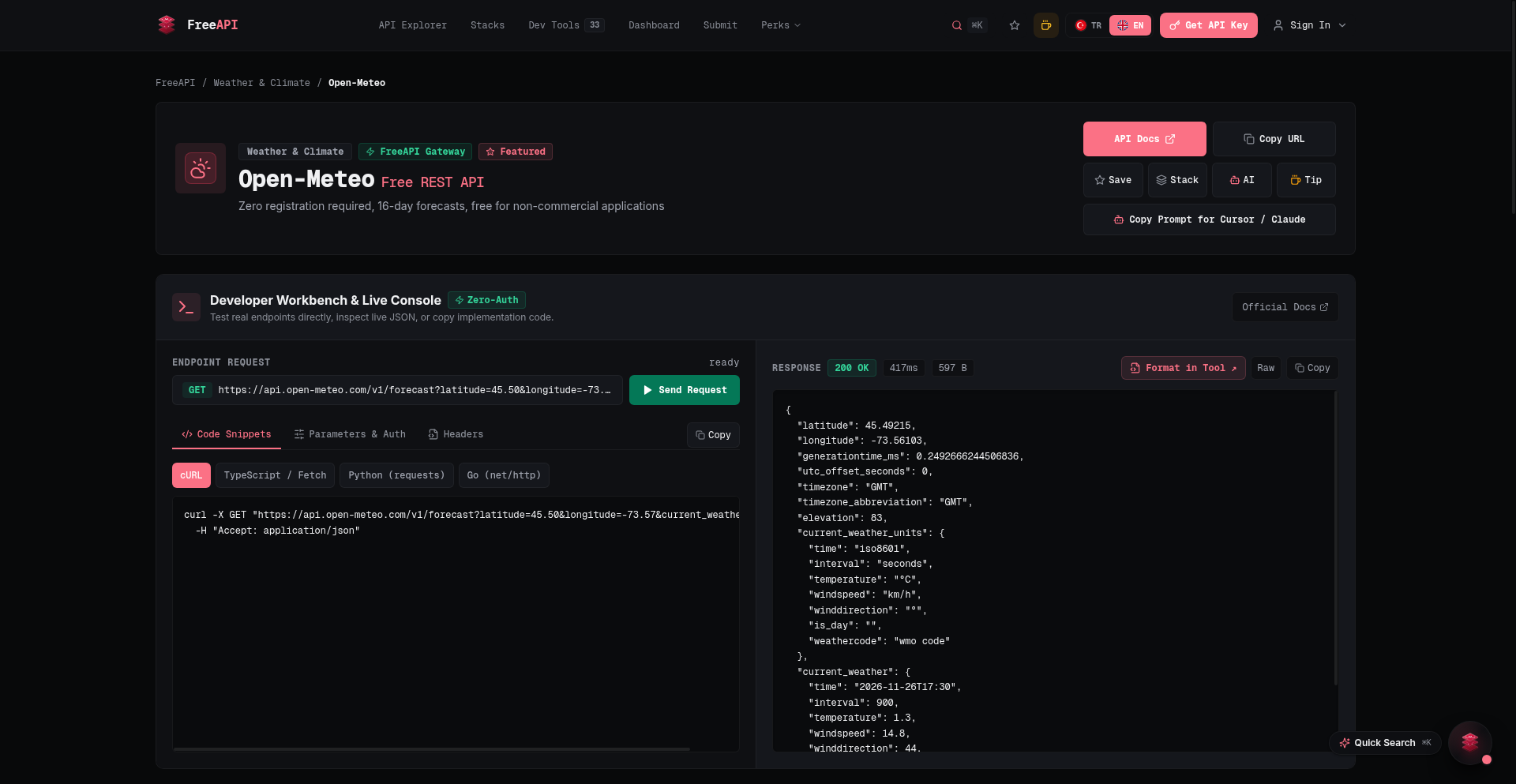
I opened the Open-Meteo page, which the site marks as needing no key. The console already held a sample request for Istanbul, so I changed the coordinates to Montreal and pressed Send Request. The answer came back as "200 OK" in 417 ms, with the temperature, wind speed and weather code for the current hour. I then sent the same request straight to Open-Meteo. The values matched: 1.3 °C, wind 14.8 km/h, direction 44 degrees. The only difference was a tiny timing field that the service computes on each call. Next to the answer, the page shows the same call as ready-to-copy code in curl, TypeScript, Python and Go.
Then I opened a service marked "Key Required", OpenWeatherMap, and pressed Send with the placeholder key left in. The site returned its own "401 Unauthorized" message and said it does not fabricate simulated data. I liked that: it does not pretend a call worked when it did not. The message points you to the provider's page to get a key and says to enter it in a Parameters and Auth tab.
The explorer
The Explorer page offers filters for No-Auth, API Key, Unlimited, CORS Open, GET, POST and HTTPS, plus a long list of categories, which the site puts at 47. The home page also mentions curated "stacks" and a set of developer tools, which I did not try. I did not check the quality of the entries beyond the two services above, so treat the "1,047+ verified" claim as the site's own.
How the request travels
This is the part to know before you paste anything private. When I sent the request, my browser's network list showed a call to the site's own proxy address, with the Open-Meteo address inside it. So the request did not leave from my browser straight to Open-Meteo. It went through FreeAPI's server first. The site's privacy page describes this as a "transparent pass-through proxy" and says keys, tokens and request contents "are never persisted or stored" in its databases. That is the site's statement, and I could not check it. A safe habit is to test with free public endpoints, and to run anything involving a real key or private data from your own machine.
The same page says it collects aggregated, anonymised usage data and reserves the right to use it for AI model tuning. I also saw requests to Google Analytics when the home page loaded, and I did not see a cookie banner.
Ads and sponsored links
The pages carry sponsored placements and affiliate-style links for hosting and scraping services. They are labelled. On the service pages they sit below the console, so they did not get in the way of the test. On the home page I saw one between the API cards.
Who it suits
It suits developers who are choosing between free APIs and want to see a real answer in a minute, without making an account or opening an editor. It is less suited to anything with secrets in it.
Sources: FreeAPI, its privacy page, Open-Meteo and the Show HN post, tested by Freewares on November 26, 2026.
Cover: screenshot of the FreeAPI console showing the Open-Meteo test, taken by Freewares on November 26, 2026.