SCORM Manifest Parser: Catch a Broken Course Reference Before Upload
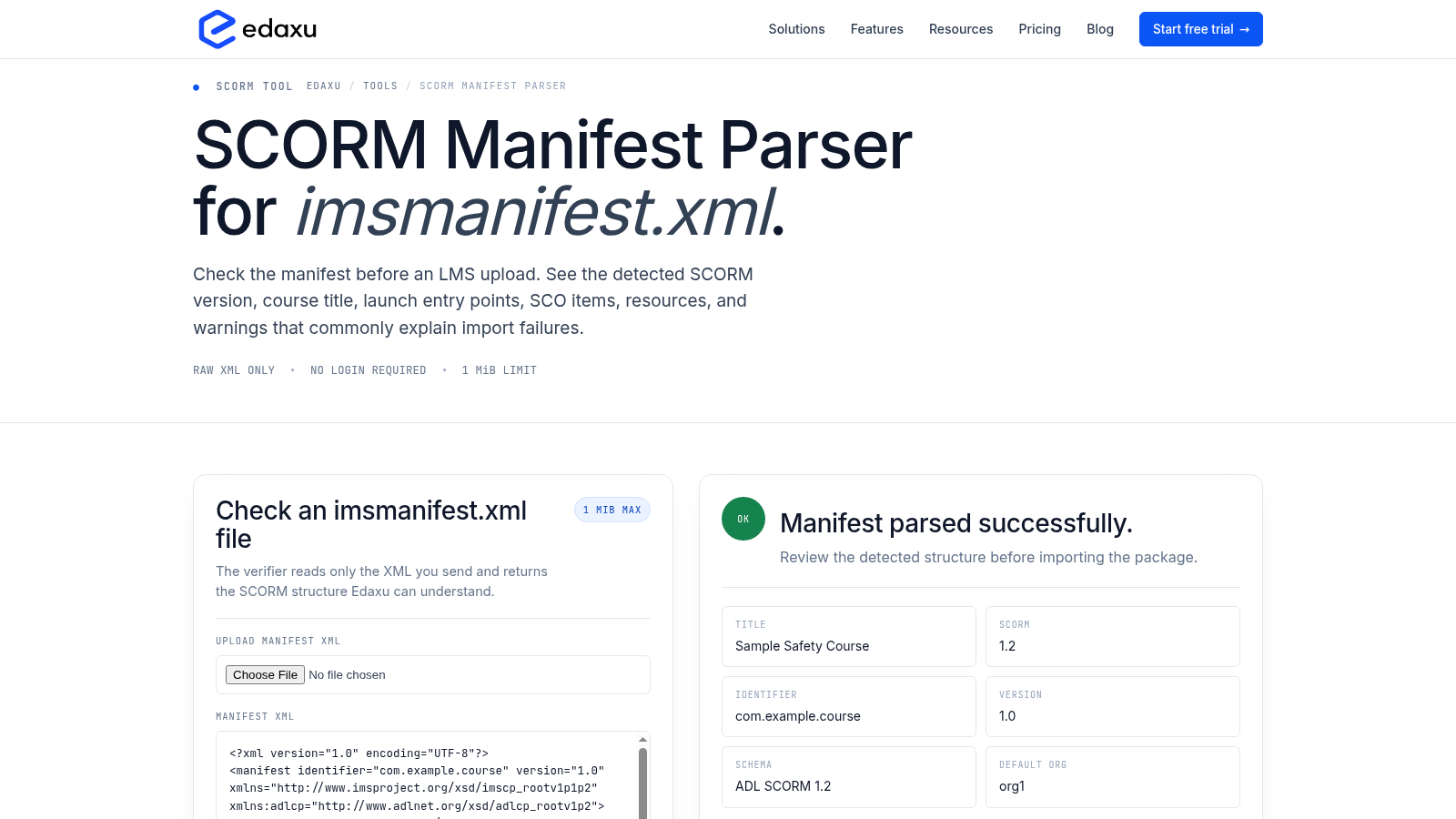
A course can have a title, a launch page and an item that points to absolutely nothing. That was the small mistake we planted in a synthetic SCORM manifest. Edaxu's SCORM Manifest Parser found the missing reference and named it, rather than leaving us to hunt through the XML.
This is a narrow tool, which is part of its appeal. Give it the raw imsmanifest.xml file, not the whole course ZIP, and it presents the structure it can read: course metadata, organization items, resources and launch entry points. During our November 16, 2026 check, we used it without creating an account or entering payment details.
The mistake we gave it
Our first file described a made-up "Sample Safety Course" using SCORM 1.2 metadata. It had two lesson items, but only one resource. Lesson 1 pointed to res1, whose launch file was lesson1.html. Lesson 2 pointed to res_missing, which we deliberately left out.
The parser returned "Manifest parsed with warnings" and this useful line: "Item 'item2' references non-existent resource 'res_missing'". It also displayed the course title, manifest identifier, package version, SCORM 1.2 label and default organization. The item table kept both lessons visible, while the resource table showed the one resource we had actually supplied.
That distinction matters. The XML was readable, but the references did not all join up. A simple view of the extracted structure made the mismatch much easier to spot than a wall of angle brackets.
Two more files, two different outcomes
Next, we submitted a deliberately unfinished XML document. This time the result was an error, not a warning: "Expected a well-formed manifest XML document". The tool did not present the broken input as a successful course check.
For the third test, we removed the second lesson item from our original manifest. The remaining item and resource matched. The parser returned "Manifest parsed successfully" and displayed the expected title, SCORM 1.2 metadata and lesson1.html entry point.
These were three small, synthetic files. We did not upload a production training course, test SCORM 2004, try every warning category or check the advertised size limit at its boundary. The results show that those particular inputs produced sensible distinctions between malformed XML, a missing reference and a matching structure. They are not a certification of the parser's coverage.
How to use it without asking too much of it
The page offers a file picker and an XML text field, plus Parse manifest, Load sample and Clear controls. Its stated limit is 1 MiB. Start with the raw manifest, run the parser and compare the entry points and resource references with the files your course is supposed to contain.
Edaxu explicitly says this is not a validator for an entire SCORM ZIP. It does not inspect every file inside the package. In our clean test, lesson1.html was only a filename written in the XML; we did not provide that HTML file at all. A successful parse therefore did not establish that a launch page existed, loaded correctly or recorded learning progress.
We also did not import anything into a learning management system. Treat the result as an early check, then test the actual package in the LMS you intend to use.
Keep real course data out of a casual test
No login does not mean a tool is necessarily local-only. We did not verify where parsing runs or how submitted XML is retained. Edaxu's general privacy policy covers its website and broader learning service, including customer content and technical data, but it does not give a parser-specific XML retention period. Use a synthetic or approved non-confidential manifest unless you have checked the handling requirements for your organization.
For someone who builds or maintains SCORM courses, this looks useful as a quick structural check. It caught the exact dangling reference we planted and separated it from malformed XML. Just keep the green result in its lane: the manifest was parsed, not the whole course tested.
Cover: Freewares test capture of Edaxu's SCORM Manifest Parser with a synthetic manifest.