BugStage: a self-hosted Git forge built for solo maintainers
An open-source project can need a home for its code, releases and support questions without needing a large collaboration platform. BugStage approaches that smaller problem directly. It is a self-hosted Git web server and discussion board designed around a single maintainer, with contributions handled through conversations rather than pull requests.
That focus makes it an interesting discovery for developers who want to host their own project hub. It also sets clear boundaries: BugStage is experimental, and its author currently recommends waiting for at least version 0.1.0 before running it on your own server.
A project home, rather than a full GitHub replacement
BugStage brings repository browsing, release downloads and project discussions into one interface. Its official site points to developer Gani Georgiev's own instance as a public demonstration, so there is a useful way to explore the idea before considering a deployment.
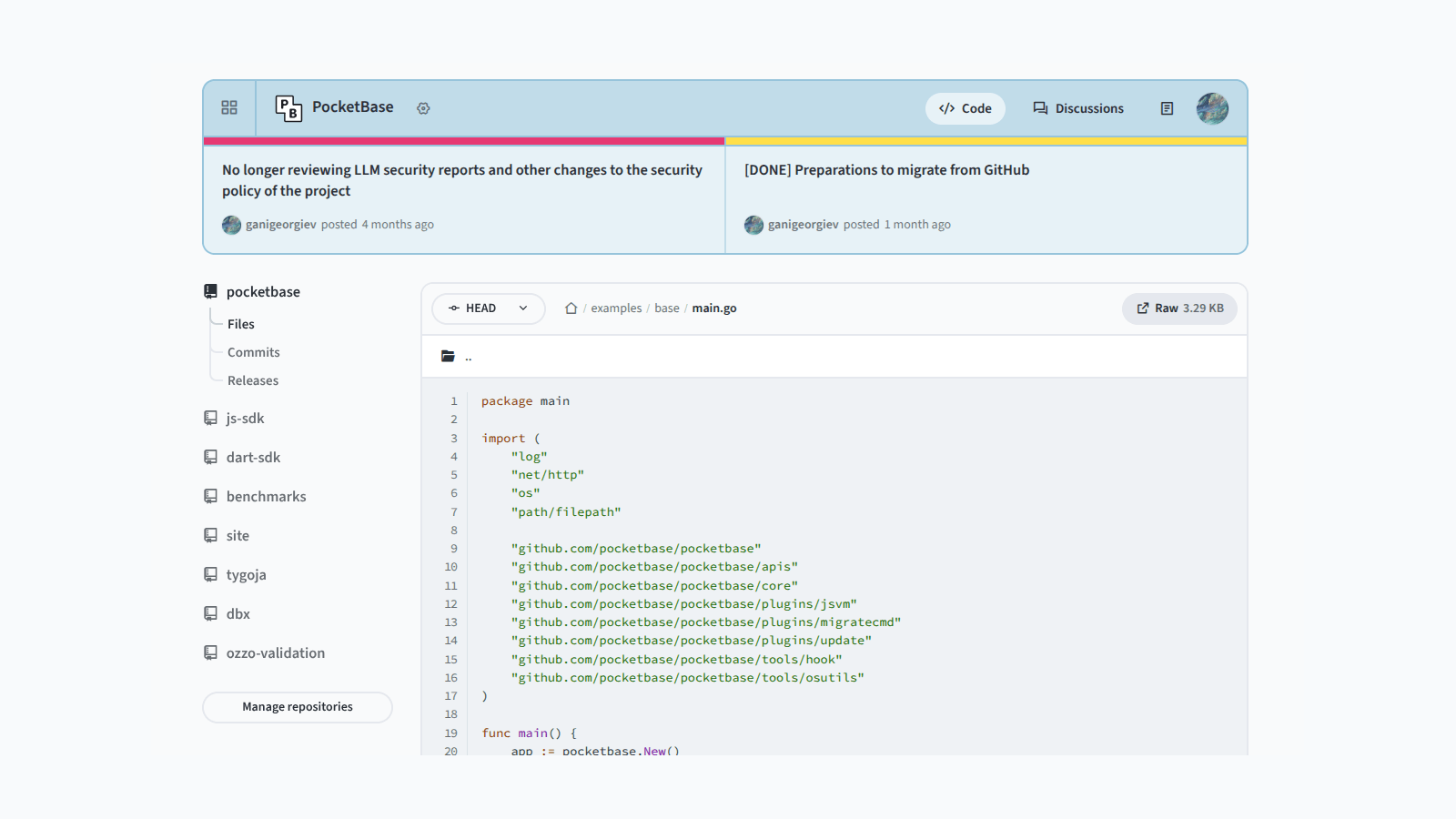
During our anonymous, read-only visit, we opened BugStage's repository, browsed its file listing, read its README and license, and inspected the releases and discussions pages. The repository view put Files, Commits and Releases in a sidebar, with a revision selector and Clone control above the files. Discussions had categories including Q&A, Bugs, Feature requests and Announcements.
This was a public-interface inspection, not an installation or a performance test. It showed how the code and conversation areas fit together without requiring us to create an account.
Why there are no pull requests
The missing pull-request workflow is a deliberate design choice. According to the official site, contributors can propose changes in a discussion, either as inline code or as an attached Git patch. The maintainer can discuss the suggestion without treating it as something waiting in a merge queue.
For a small project, that may suit a developer who wants occasional, focused contributions rather than a shared development process. It is a less suitable match if your contributors expect branch-based reviews and a familiar pull-request workflow. The tradeoff is about how the project works, not simply how many features appear in a menu.
There is no CI/CD system out of the box either. The documentation describes using PocketBase server-side hooks and Web APIs to build custom automation. Exposed Git hooks are not currently available. Those extension options should not be mistaken for a ready-made build pipeline.
Free software, with a server to manage
BugStage is free and open source under the MIT license. It is built with PocketBase and Shablon and distributed as a single prebuilt executable. At the time of our visit, the releases page listed version v0.1.0-rc.10 on its experimental channel, with archives for Linux, macOS and Windows, including x64 and ARM64 builds.
The documented local setup starts with extracting the archive and running ./bugstage serve. A PocketBase installer creates the first superuser, followed by an initial maintainer account. The README also describes backup, storage, mail and authentication settings through the PocketBase dashboard.
A compact package does not remove the work of operating a server. Hosting, backups, access controls and updates remain the operator's responsibility, and any hosting bill is separate from the software's free license. For now, the author's prerelease warning matters more than the convenience of the startup command.
The limits that decide whether it fits
Permissions are a major constraint. BugStage has three access levels: guest, regular user and maintainer. Regular users can participate in discussions and subscribe to project events, but their Git access remains read-only over HTTPS. Maintainers have broad administrative powers and Git write access over SSH.
The official site says there is no support for inviting external collaborators or moderators with narrower roles. That makes the solo-maintainer description a practical boundary, rather than a label that can be ignored when adding a team.
Repository size is another consideration. The author warns that the go-git implementation is not optimized for repositories with long histories and many references, and that memory use can be an issue. He suggests shallow clones as a way to reduce clone times. The README recommends enabling swap and warns of possible security issues; it also says CVEs will not be managed for prereleases.
Worth exploring, not rushing into production
BugStage has a clear audience: a solo open-source maintainer who wants a self-hosted place for code, releases and community discussion, and accepts a discussion-first contribution model. Its appeal is that it does not try to cover every team workflow.
The sensible next step is to browse the public demo and compare that model with your project's needs. If you need fine-grained team permissions, integrated CI/CD or predictable large-repository performance today, the documented limits are reasons to look elsewhere. For everyone else, BugStage is a project to watch as it moves beyond its experimental releases.
Sources
Project screenshot showing PocketBase in BugStage. © 2026-present Gani Georgiev. Original image centred on a neutral background. Source · MIT license.