Hookdeck Inspect: A Webhook Tester Your AI Agent Can Read
- Webhooks
- Developer Tools
- Debugging
- Free Tools
- API
Some tools solve a problem you did not know had a name. Webhook debugging is one of them: the provider swears it sent the POST request, your app swears nothing arrived, and you lose an hour staring at logs that say nothing. Request bins have existed for years to catch exactly that. Hookdeck Inspect, launched on Product Hunt at the end of October, is the newest one, with a twist aimed squarely at 2026: it is built to be read by your AI coding agent, not just by you.
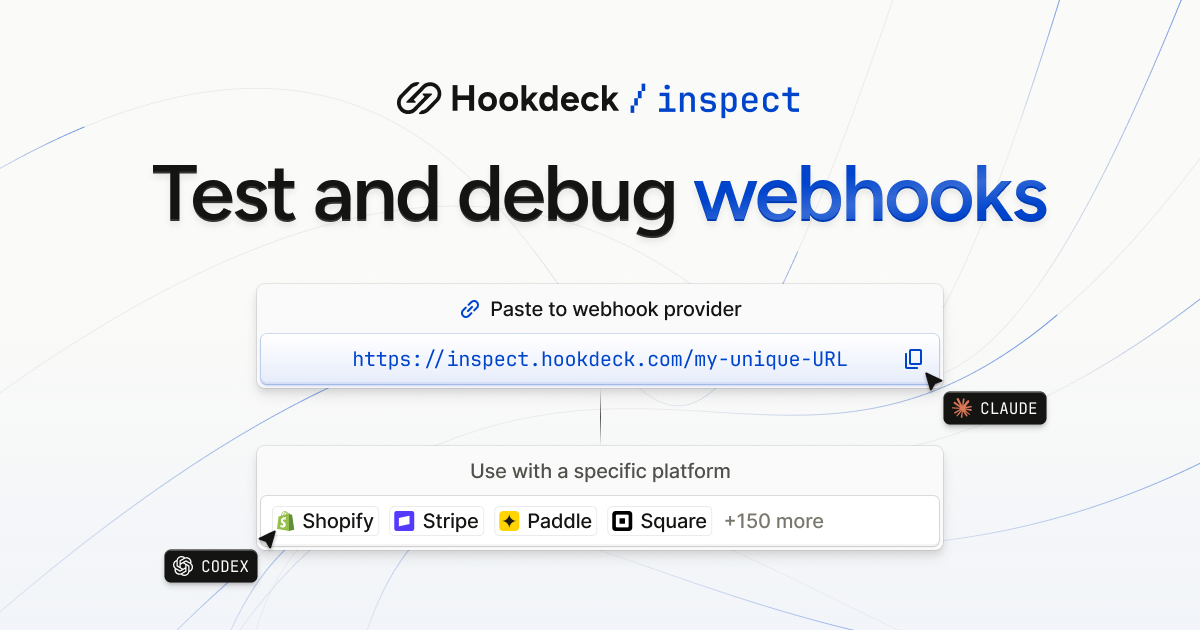
Hookdeck Inspect: a live request URL to paste into any webhook provider, readable by your coding agent. Source: inspect.hookdeck.com.
What it is
Hookdeck Inspect gives you a live URL the moment you land on the page. Point any webhook provider at it and you watch requests arrive in real time, with the payloads exactly as they were sent: headers, body, everything. No account, no setup, no credit card. It is free.
The people behind it are Hookdeck, a webhook infrastructure company whose paid products (Event Gateway for receiving, Outpost for sending) process, they say, billions of webhooks every week. Inspect is their free, stripped-down entry point, and it is deliberately separate from those paid offers.
The agent angle
Here is what makes this launch different from the request bins you already know. The makers describe Inspect as "agent-native": you can paste your Inspect URL into Claude or Codex, and the agent can tell when a request lands, read the payload, and use it to build your handler. No skills to install, no MCP server, no configuration. The URL is simply readable by anything that can fetch a web page, which includes most coding agents.
If you have ever debugged a Stripe or Shopify integration by copy-pasting payloads into a chat window, you see the appeal immediately: the agent fetches the payload itself.
Mock webhooks for 500+ providers
The other headline feature: Inspect ships mock webhooks for more than 500 providers, including Stripe, Shopify and GitHub. That means you can develop and test your handler without touching a real provider account, a sandbox dashboard, or a test credit card number. For side projects especially, this removes the most annoying part of webhook development.
There is also a path to production: a CLI can forward requests to your localhost during development, and when you outgrow the free tester, Hookdeck's Event Gateway adds queues, retries and transforms. That last part is where the paid product starts, and it is clearly the business model: Inspect is the free on-ramp.
What we have not verified
This is a first look based on the launch, not a hands-on review: we have not pushed a real provider's webhook through it yet. Two things worth keeping in mind. First, your payloads transit Hookdeck's servers, so keep test data in it rather than anything sensitive from production. Second, features like signature validation on the mock webhooks were still being discussed in the launch comments, so treat the fine details as evolving.
Verdict
If you integrate webhooks for a living, or for a weekend project, Hookdeck Inspect looks like the lowest-friction way to see what is actually arriving at your endpoint: free, no signup, live in seconds. The mock webhooks for 500+ providers alone make it worth bookmarking, and the agent-readable URL is a genuinely smart touch for anyone who codes with an AI assistant. A request bin did not need reinventing, but this is a thoughtful update of the idea.
Cover image: the Hookdeck Inspect app live at inspect.hookdeck.com.
Getting it
Hookdeck Inspect is free and runs in the browser, with no account required. It is a hosted service, so there is nothing to download.