Ram-Altman: We Checked the RAM. It Became a Threat Report.
- Linux
- open source
- RAM
- Bash
- humor
For this review, we tried Ram-Altman's preview mode on Linux. No recipient configured, no mail sent. Just a small script being asked a small question: what would you write?
The subject came back: "Unused RAM detected in the wild".
Already, I had concerns about the word "wild." It's memory, not an escaped zoo animal.
Then came the daily status report, including this line:
Threat level: someone at OpenAI might notice
The sign-off: "Yours in abundance,"
I went looking for a memory monitor and found a tiny civil service with a sense of humour. That, in one preview, is Ram-Altman: a free Bash script that turns available Linux memory into politely ridiculous correspondence.
The premise is to let Sam Altman know about the RAM that has somehow escaped into a personal computer. The preview gave us the entire joke without requiring anyone else's inbox to participate.
A tiny script, a very important imaginary department
The joke comes from Altman's comments on the Cheeky Pint podcast about the global allocation of DRAM and memory sitting in personal computers "being used five percent of the time." As The Verge reported, he later said the remarks were taken out of context, wanted people to have as much memory as they wanted, and briefly used the name "Ram Altman" on X.
That clarification matters. This is a parody of a public argument, not evidence of a plan to confiscate your DIMMs. Nobody needs to hide a memory stick in the biscuit tin.
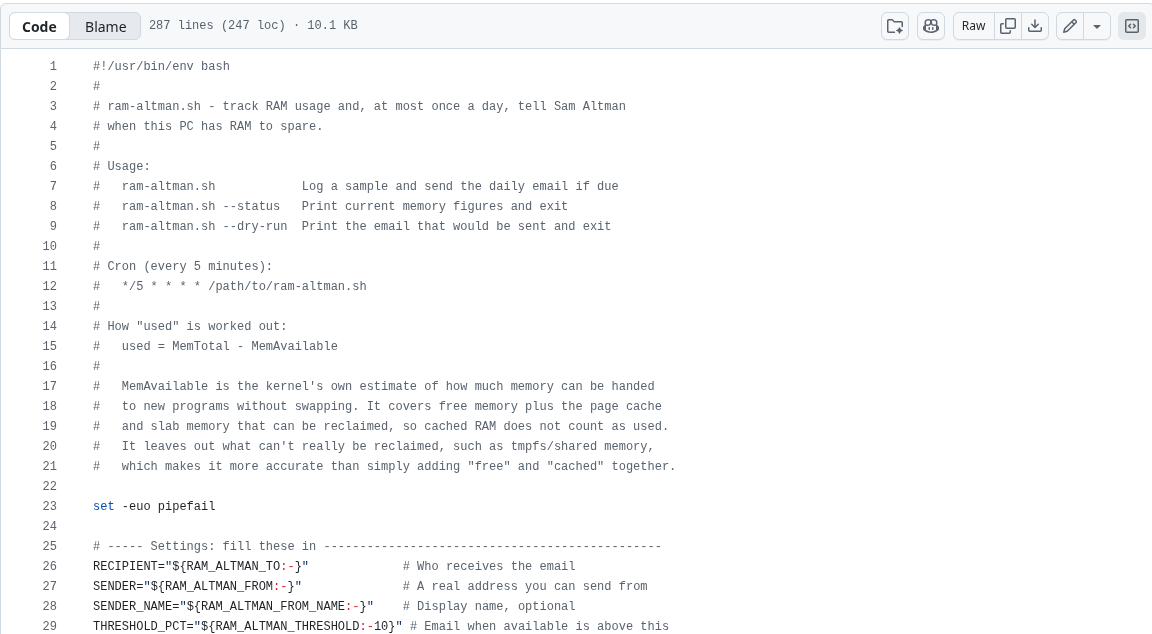
Developer IainKay's response was to give the joke a command line. With its default threshold, Ram-Altman considers more than 10% available memory worth reporting. It has eight subject lines, ten message templates and six sign-offs, including "Hoarding responsibly."
My favourite detail is the sheer administrative seriousness of it. Your computer has some breathing room. Naturally, we need correspondence.
The memory accounting is less silly than the premise
The script reads Linux's /proc/meminfo. Its main calculation is total memory minus MemAvailable, the kernel's estimate of what applications could claim without swapping.
That includes reclaimable cache. It doesn't simply spot a small "free" number, panic and announce that Linux has eaten the furniture.
There is a CSV log, too, plus a test script using simulated memory and a fake mail command. Our hands-on check was narrower: --status and --dry-run both completed successfully. We did not run the automated test suite, configure scheduled monitoring or test mail delivery. A successful preview is a successful preview, not a lifetime achievement award for reliability.
One distinction is worth keeping: how much memory is available at a particular moment is not the same measurement as how much of the time a computer is busy. The project itself acknowledges that. This is a good joke, not a scientific rebuttal disguised as an email footer.
The joke works perfectly well in preview
I'd start with the website's sample emails. No installation, no configuration, no explaining yourself to anyone's spam filter. The script's --dry-run mode prints a preview without sending mail; --status just shows the memory figures.
Real sending is optional. It needs a recipient you configure, a sender address and a working mail command such as sendmail, msmtp or mail. The repository supplies no one's address. Its example cron job checks every five minutes, but the script tracks successful sends to limit correspondence to once per day.
The README recommends preview mode and warns against an inbox flood. Fair enough. The joke survives perfectly well without delivery confirmation.
A utility? Technically. A priority? Absolutely not.
Ram-Altman is free, published under the Unlicense, and aimed at Linux rather than macOS or Windows. It will not increase your RAM, speed up your computer or solve the memory supply problem.
What it offers is smaller and, to me, more appealing: a piece of software with one very specific grievance and excellent commitment to the bit.
The line that stayed with me wasn't a memory figure. It was that threat level. A computer with room to spare had somehow become an incident requiring a salutation.
We closed the preview. Nobody received an email. The RAM remained stubbornly unreported.
A productive evening, by the standards of this project.
Cover: cropped view of Ram-Altman's source code on GitHub, by IainKay, under the Unlicense. Source view, not an execution or test screenshot.