Scrapling: The Python Scraping Library That Fights Back
- Open Source
- Development
- Python
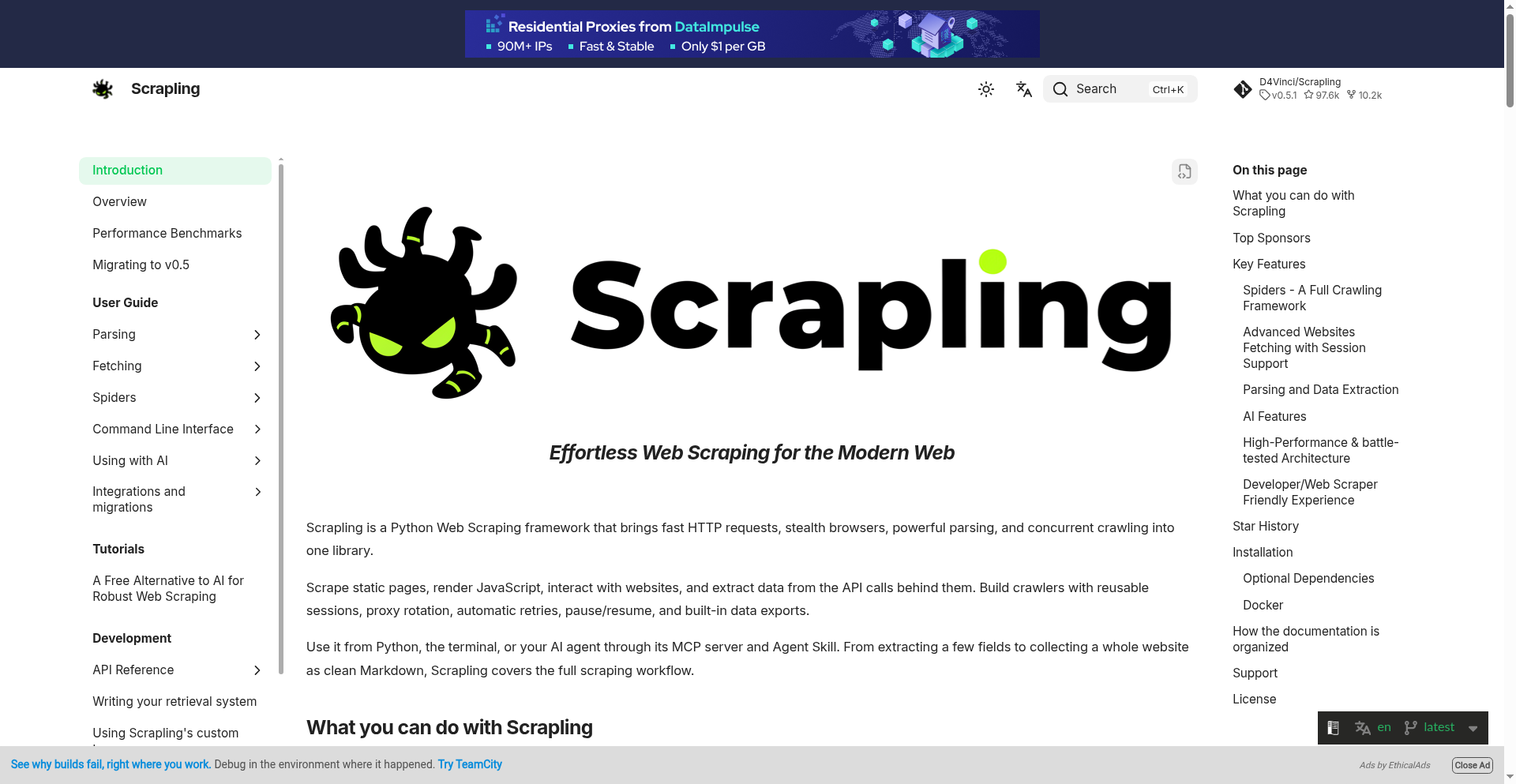
Every few months I go shopping for a scraping library the way other people go shopping for a new notes app: full of hope, certain that this time the thing will just work. The ritual ends the same way, with a Playwright install that needs three system dependencies, a Cloudflare wall, and me reconsidering my life choices. So when a Python scraping library blows past 97,000 GitHub stars, I pay attention.
Scrapling is that library. It is free, open-source (BSD 3-Clause), written by Karim Shoair (D4Vinci), and it pitches itself as an "undetectable, adaptive" scraping toolkit for the modern web. Version 0.5.1 is current on PyPI, requires Python 3.10 or later, and installs with a simple pip install scrapling.
What it actually does
Scrapling bundles the whole scraping workflow into one library. Its plain Fetcher handles fast HTTP requests for static pages. According to the documentation, the StealthyFetcher routes through a hardened browser built to handle JavaScript-heavy pages and anti-bot systems such as Cloudflare, without you wiring up a separate stealth plugin. On top of that sits a real crawling framework: spiders with pause and resume, an AutoThrottle that adjusts request rates to stay polite, and session support for sites that need you logged in.
The parser is the part users tend to rave about: it is fast, keeps a memory of where elements were, and, per the docs, is designed to relocate them when the site redesigns and your selectors break. That "adaptive" bit is the difference between a scraper that survives a frontend update and one that dies silently at 3 AM.
It also ships an MCP server, so AI agents like Claude can drive it directly, and it exports results to JSON, JSONL, CSV or XML without extra plumbing.
The command line is not forgotten either: you can fetch and parse pages straight from the terminal for quick one-off jobs, without writing a script first.
Why it is having a moment
Scraping in 2026 is an arms race. Sites hide behind behavioral detection, and the old requests-plus-BeautifulSoup stack bounces off anything serious. Scrapling's bet is that one well-maintained library should handle the detection evasion, the rendering, the parsing and the exporting, so you spend your time on the data instead of on infrastructure. Judging by the star count, a lot of developers agree.
The honest fine print
I have not run Scrapling against my own target list yet, so this is based on the documentation, the changelog and the community's feedback rather than a weekend of personal testing. A few things worth knowing:
- Stealth features lean on a real browser engine under the hood, so the first install pulls browser dependencies. Not heavy, but not a pure-Python pip install either.
- Anti-bot bypasses are an arms race: what beats Cloudflare today may need an update tomorrow. The project is actively maintained, which matters more here than any feature list.
- It is a library, not an app: you write Python. If you want point-and-click scraping, this is not that.
- As with any scraping tool, check the target site's terms and robots.txt. The tool being able to fetch a page does not mean you should.
Who this is for
Python developers who scrape for a living or for side projects, data people tired of maintaining a Playwright-plus-plugins stack, and anyone building AI pipelines that need clean web data, since the MCP server makes it a first-class tool for agents. If your current stack is three libraries held together with hope, Scrapling is worth the hour it takes to try.
The full breakdown, versions, requirements and links, is on the Scrapling software page.
Image credit: Scrapling documentation (scrapling.readthedocs.io), BSD 3-Clause project.