Why That Move: Put Your Chess Mistakes Back on the Board
- Chess
- BrowserTools
- Freemium
A chess engine can tell you that a move lost six pawns of advantage. Lovely. It has quantified the disaster. What I usually want next is a sentence explaining what I missed.
Why that move builds its pitch around that gap: a browser-based chess review with plain-language notes from Bodhi, alongside the board and engine analysis. It is a freemium service with recurring free credits, not unlimited free coaching.
The interesting bit is the connection to the board
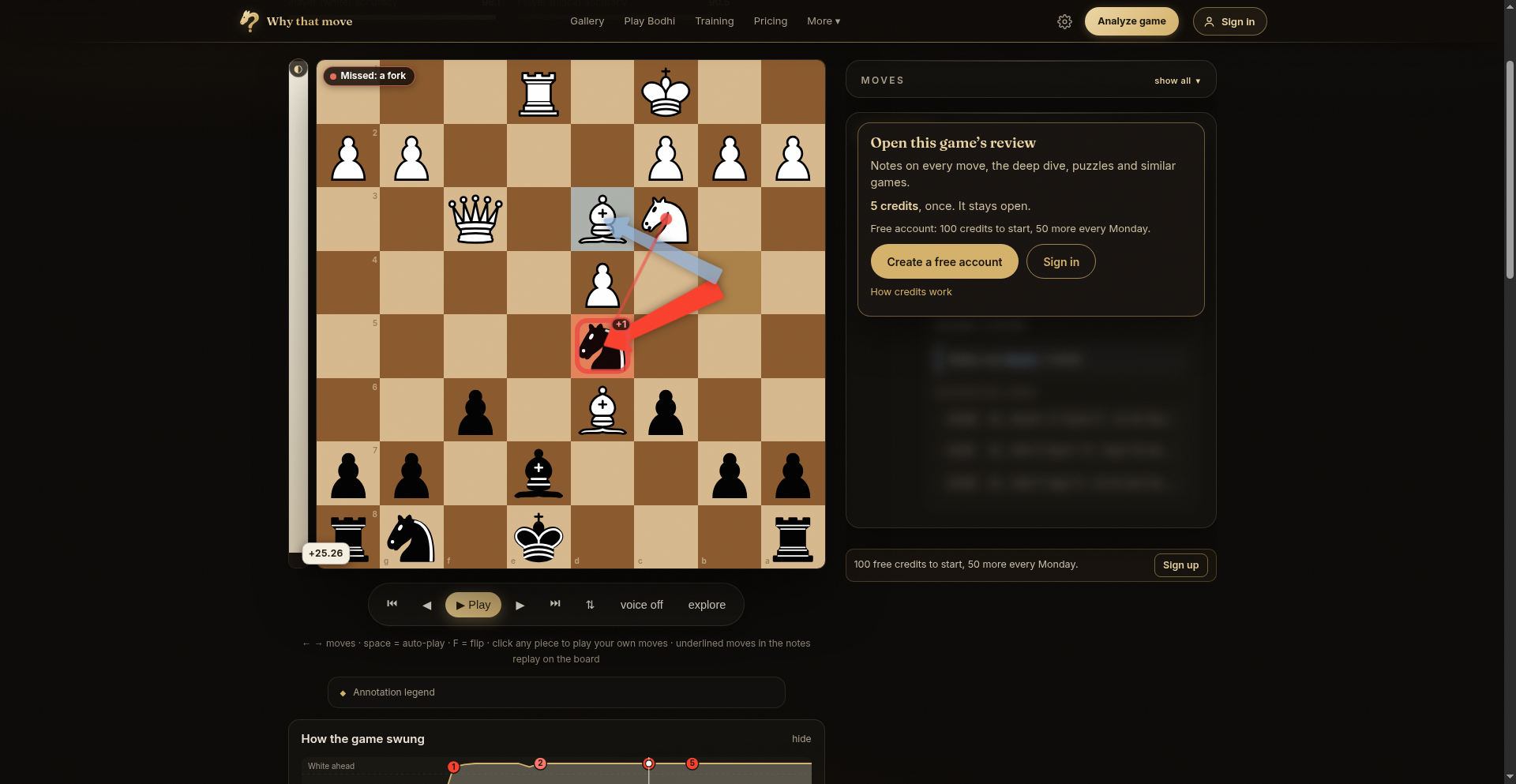
I explored a public Vienna Gambit game from the site's gallery. Its summary offered a biggest-swing button, 16...Nd5. Clicking it moved the replay to that position and put arrows and a highlighted knight on the board. Stepping forward changed the position again; flipping the board switched the view to White's side.
That is the part I like about this approach. A number on an evaluation graph is easy to skim and forget. A position you can step through gives you something to investigate. The replay also showed an opening label, accuracy figures, key moments on the graph and a summary of costly errors. I would use those as signposts back into the game, rather than treating an accuracy score as a certificate of chess intelligence.
The full written review for that public game sat behind an account-and-credit prompt. This exploration covers the public replay and the published credit model, not a completed Bodhi review of my own game.
What Bodhi is supposed to add
The site's workflow starts with a game from Chess.com or Lichess. Its selling point is a note explaining each move and what would have been stronger, plus a deeper overview and practice based on mistakes. The homepage gives a simple example: a knight move that forks the king and rook, explained in words instead of just a line of notation.
For someone learning, the useful question is whether the explanation helps you spot the same pattern next time. I would start with a game containing one mistake you already understand. Compare that moment with the board, follow the suggested line, then see whether the explanation makes the idea clearer. More words are only an improvement if they teach you something.
Count the credits before planning a daily habit
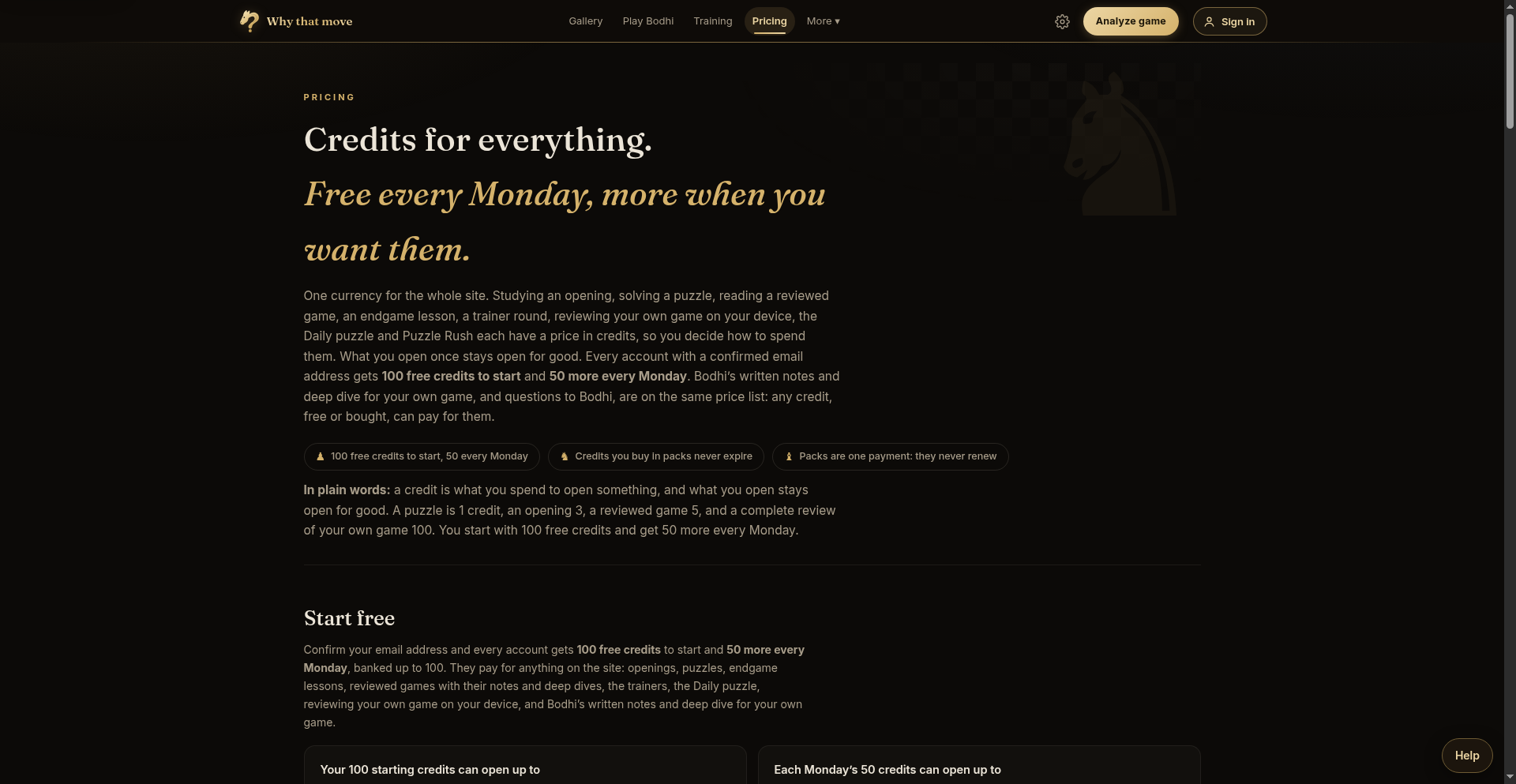
The current pricing page is more precise than the short homepage pitch. A confirmed-email account receives 100 starting credits, then 50 every Monday (UTC). Free credits bank up to 100. Different activities draw from that same balance:
- A local instant review of your own game: 10 credits.
- Bodhi's written notes and deep dive together: 90 credits, on top of the instant review.
- A complete review with both: 100 credits.
- Opening a reviewed library game with its notes and deep dive: 5 credits.
- A puzzle: 1 credit.
So the weekly allowance can cover five local instant reviews or ten library reviews, if spent only on those activities. A complete 100-credit review uses the starting balance; after that, saving two Monday grants covers another one. The free tier can support a modest study routine, but not a new complete Bodhi review every day. Paid packs and memberships are listed for heavier use. Bodhi's written reviews and questions funded with free credits also share a daily limit across all accounts. Having enough free credits does not guarantee those features are available that day; the pricing FAQ says free-credit requests must wait until the next day when that shared allowance is exhausted.
Your review is not private
Before submitting a game, read the privacy policy. It says completed reviews are automatically published to the public gallery, apart from very short games. Hiding player names does not make the review private. Authors can remove their name and the original-game link afterwards, but cannot delete the published review themselves. Cloud notes and deep dives also send game data to a language-model provider. That is a different arrangement from keeping a chess analysis entirely on your own machine.
Who I would point toward it
Why that move is worth a look if you enjoy revisiting a game but find raw engine lines a little too much like receiving feedback from a calculator. The public replay is an easy way to see the interface before creating an account. If that style clicks, the starting credits give you room to compare the different kinds of review before deciding whether you want more.
My starting point would be one game and one missed idea, not an ambitious training dashboard. Understand why the knight was hanging. Then worry about the rating graph.
Exploration and pricing checked November 20, 2026. Images are our captures of Why that move's public replay and pricing page. Public example: Vienna Gambit game. Service content belongs to its respective owners.